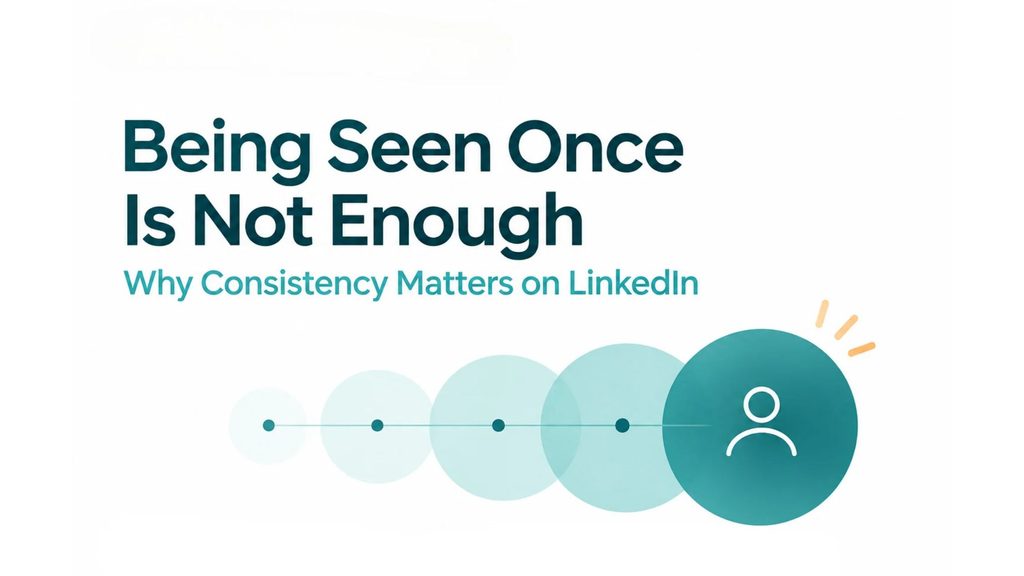
Why Consistency Matters on LinkedIn
Most of us have had this experience.
We meet someone at an event. We exchange a few words. Perhaps we even exchange business cards or connect on LinkedIn.
A few months later, we see the person again.
The face looks familiar. The name looks familiar. But we cannot quite remember what they do.
Now imagine the opposite.
We meet someone briefly. A few days later, we notice an interesting comment from them on LinkedIn. A week later, we see a post where they explain something related to their area of work. Later, someone in our network engages with another post from the same person.
Gradually, something changes.
We do not merely recognise the name anymore. We begin associating that person with a subject.
“She works in manufacturing productivity.”
“He is the person who keeps talking about family-business succession.”
“They understand B2B technology marketing.”
Nothing dramatic happened. There was no viral post. No clever campaign suddenly converted us into a customer.
We simply encountered the person often enough, and consistently enough, to remember what they stood for.
That is an important part of LinkedIn growth which gets far less attention than impressions, followers and posting frequency.
Visibility helps people notice us. Consistency helps people remember us.
Last month we spoke about visibility
In our previous DIY Marketing article, LinkedIn Visibility: Are the Right People Seeing You?, we argued that a large number of impressions does not automatically mean good marketing.
The more useful question is whether the people relevant to our business are seeing us.
But there is another question we need to ask after we have solved the visibility problem.
Suppose the right people are seeing us.
Will they remember us tomorrow?
That is where consistency enters the picture.
Consistency does not mean posting every day
This is probably the first misunderstanding we need to clear up.
When people hear the phrase “be consistent on LinkedIn”, they often translate it into a publishing schedule.
Post every day.
Post three times a week.
Post every Tuesday and Thursday.
There is nothing wrong with having a content schedule. In fact, a sensible rhythm makes execution easier.
But frequency and consistency are not the same thing.
Someone can publish every day and still be remarkably inconsistent.
Monday’s post is about leadership.
Tuesday is an inspirational quote.
Wednesday discusses artificial intelligence.
Thursday contains a photograph from a networking event.
Friday promotes the company’s service.
The person has been very active.
But after five posts, what should we remember them for?
That is the harder question.
Consistency is not simply about how often we communicate.
It is about whether our communication repeatedly reinforces a recognisable professional identity.
A person who writes once a week about different aspects of one area of expertise may therefore build stronger recall than someone who publishes every day about whatever happens to be popular.
Frequency creates activity. Consistency creates association.
Think about the brands we remember`
This idea is hardly new.
Brands have always understood the importance of repetition.
We recognise a brand from its colours. A few notes of music may bring another brand to mind. A phrase, shape, packaging style or advertising theme can create an immediate association.
The objective is not simply to show the same advertisement repeatedly.
It is to make certain ideas easier to connect with the brand.
The same principle works for professional visibility, although it needs to be handled much more naturally.
If someone repeatedly encounters a consultant discussing practical challenges around manufacturing operations, they begin connecting that consultant with manufacturing expertise.
If a financial professional consistently explains investment decisions without turning every conversation into a product recommendation, people begin associating that person with financial judgement.
If a founder regularly discusses lessons from building a business—not generic motivational lessons, but real decisions, mistakes and observations—the audience begins understanding how that founder thinks.
Eventually, the name itself begins carrying context.
That is what we are trying to build.
Not simply another impression.
Recognition.
Why one excellent post is rarely enough
Every now and then we create a post we are particularly proud of.
It says exactly what we wanted to say. The engagement is good. The right people respond. Perhaps it even travels much further than expected.
Excellent.
But most people who saw it will still forget it.
That is not because the content failed. It is simply how attention works.
LinkedIn and Edelman’s B2B thought-leadership research has previously found that 55% of buyers move on when content does not capture their interest within the first minute, while 56% say they save thought-leadership content intending to return to it but never actually do. The same research stresses the importance of repeatedly delivering credible and useful insight rather than treating thought leadership as a one-off activity.
That should not discourage us.
It should change our expectation.
We do not need every person to remember every post.
We need the overall body of our activity to gradually make us easier to recognise.
One post might introduce us.
Another reinforces the subject.
A comment demonstrates experience.
A client story adds proof.
A different post explains a related problem.
Over time, the individual pieces start supporting one another.
“But haven’t we already spoken about this?”
This is another question we hear from experienced professionals when discussing content.
“We wrote about this six months ago.”
“I have already spoken about this subject.”
“Won’t people get bored?”
Usually, we are far more conscious of our repetition than our audience is.
We see everything we publish.
Our audience does not.
Some followers miss the first post. Some joined our network afterwards. Some saw it but did not pay much attention. Some understood the idea only after encountering it in another context.
More importantly, expertise naturally contains recurring themes.
A doctor does not stop talking about preventive health because they have already discussed it once.
A lawyer does not abandon the subject of contracts because they wrote about agreements last year.
A marketing consultant does not need a completely new philosophy every Tuesday.
What changes is the angle.
Take one broad subject such as LinkedIn visibility.
We could discuss:
- whether the right people are seeing us;
- why profile positioning affects visibility;
- how commenting creates visibility;
- why more impressions do not necessarily mean more business relevance;
- what profile views tell us;
- how relevant connections reshape our network;
- why repeated visibility creates familiarity.
Same broad expertise.
Different questions.
That is not repetitive content.
That is building depth around a subject.
Consistency should make us recognisable, not predictable
There is a balance here.
We do not want every post to sound identical.
We do not want the same opening, the same format, the same conclusion and the same message repeated endlessly.
That becomes mechanical.
Consistency should exist underneath the content, not necessarily on its surface.
The stories can change.
Formats can change.
A post may be serious. Another may be light-hearted.
One may contain research. Another may come from a client conversation.
One could challenge a popular assumption. Another could simply explain something useful.
But behind all of them, the audience should gradually recognise the same expertise, judgement and personality.
That is a much more useful definition of consistency.
What should actually remain consistent?
For professional visibility, we would focus on a few things.
Our professional identity
When someone sees our name repeatedly, what broad association are we trying to build?
This does not mean reducing an experienced professional to one narrow keyword. Most of us have multiple capabilities.
But there should still be a recognisable centre.
For example, someone may know marketing strategy, content, social media, search, lead generation, email and marketing technology.
The individual capabilities are different.
The professional identity connecting them might be a marketing expert helping businesses succeed in a Digital World.
The breadth remains.
But the audience gets a simple way to understand it.
The problems we choose to discuss
Expertise becomes easier to recognise when we repeatedly help an audience think about a related set of problems.
Notice the word problems rather than services.
A consultant who offers cybersecurity services does not need to repeatedly post, “We provide cybersecurity services.”
They can discuss why employees remain a security risk, what businesses misunderstand about ransomware, how smaller companies evaluate security investments, what happens after a breach, or why compliance does not automatically mean security.
The service sits in the background.
The expertise stays in the foreground.
Our point of view
Two professionals can understand the same subject and still see it differently.
That difference is useful. Perhaps we believe businesses focus too heavily on lead generation before establishing credibility. Perhaps we believe company communication works better when experts behind the business are visible. Perhaps we believe AI should support professional judgement rather than replace it.
These views do not have to appear word-for-word in every post.
But when our ideas are reasonably consistent, people gradually understand how we think.
That is much more memorable than simply knowing our job title.
Our behaviour
Consistency is not limited to content.
If we publish thoughtful articles but respond to other people with generic comments such as “Great post”, the experience is inconsistent.
If our profile positions us as an experienced consultant but every post is a sales promotion, there is another inconsistency.
If we speak about relationships but send a sales message immediately after every new connection, people notice that too.
Our activity contributes to our positioning.
The way we engage is part of the brand people form around us.
LinkedIn consistency happens outside our own posts
This is particularly important.
LinkedIn is not only a publishing platform.
It is a professional network.
Someone may first notice us beneath another person’s post because we added something useful to the discussion.
They may notice us again in a mutual connection’s conversation.
Later, one of our own posts appears.
Eventually they visit our profile.
At no stage did we need to publish every day.
We simply participated consistently in the right professional environment.
This is why we should not measure LinkedIn activity purely through the number of posts published.
A thoughtful comment may sometimes build more relevant visibility than another post.
A useful reply can demonstrate expertise.
A connection accepted for a genuine professional reason can become part of our network for years.
A private conversation may eventually become a business opportunity.
Publishing matters.
Participation matters too.
From Seen to Recognised to Remembered
We can think about this as a simple progression.
SEEN
Someone encounters our name, profile, comment or post.
This is visibility.
They may notice us or scroll past us. At this stage, we are simply one of many people in their professional environment.
RECOGNISED
They encounter us again.
The name looks familiar.
Perhaps they remember having read something useful earlier.
We have moved from being completely unknown to vaguely familiar.
REMEMBERED
Repeated encounters begin creating an association.
“This is the person who talks about…”
Now the professional identity is becoming clearer.
This is where consistency starts paying off.
TRUSTED
Trust takes longer.
People look for evidence. They notice our experience. They see whether what we say remains sensible over time. They may look at recommendations, clients, work, conversations and how others respond to us.
Eventually, when a relevant need appears, we are no longer a stranger.
Seen → Recognised → Remembered → Trusted.
There is no fixed timetable for this journey.
And importantly, not everyone who goes through it will become a customer.
That is perfectly fine.
Consistency becomes even more important in B2B
Many B2B decisions take time.
The person noticing our content today may have no immediate requirement.
They may not control the budget.
They may not even be the ultimate buyer.
LinkedIn’s 2025 research with Edelman highlighted the importance of these less-visible stakeholders or “hidden buyers”. The research noted that more than 40% of B2B deals can stall because of misalignment within buying groups, reminding us that influence often extends far beyond the person directly talking to the seller.
This makes professional familiarity particularly valuable.
Recent LinkedIn thinking around B2B creators makes a similar distinction: the professional voices gaining influence are not simply chasing reach; they are subject-matter experts and industry voices whose knowledge creates conversation and buyer confidence.
A simple consistency check
Once a month, look at your recent LinkedIn activity as though you were seeing yourself for the first time.
Do not start by counting posts.
Instead ask:
If someone saw three or four pieces of our activity this month, what would they think we know about?
Then:
Does that match what we actually want to become known for?
There is no magic number of times someone needs to see us before they remember us. The popular marketing “Rule of 7” is better treated as a rule of thumb than a proven formula. Research does, however, consistently show that repetition improves recall. One large meta-analysis of advertising studies found that recall continued to increase through repeated exposure and had not levelled off even by the eighth exposure. The lesson is not that we must appear exactly eight times. It is that one appearance is rarely enough to create familiarity.
Visibility helps people notice us. Consistency helps people remember us.
Building consistency without making LinkedIn another full-time job
None of the activities we have discussed is particularly complicated on its own.
The challenge is maintaining the right combination of profile positioning, relevant networking, useful engagement, content and follow-up consistently enough for visibility to become recognition, credibility and eventually trust.
That is the thinking behind FrogJump, our expert-led LinkedIn growth service, supported by AI and automation.
FrogJump helps founders, consultants, experts and businesses build a more systematic LinkedIn presence while retaining the human judgement that meaningful professional relationships require.
Visibility → Credibility → Trust.
HOP. JUMP. LEAP. Start where you are. Grow from there.
Explore FrogJump at frogjump.in.